

The secret to a lovely garden is colorful margins that last! Check out these border plants that bloom nonstop from spring to fall.
It is good to have a beautiful garden, but do you know what can take it to the next level? Border plants, in fact, the ones that bloom continuously from spring to fall, will completely transform your space. Read on!
Border Plants That Bloom from Spring to Fall
1. Coneflower

Botanical Name: Echinacea purpurea ‘Magnus’
USDA Zones: 3-9
If you want bold-colored borders, Coneflowers are a great option. These hardy perennials give out daisy-like, large blooms in vibrant shades of pink, purple, and white that bloom up to the fall season.
2. Tickseed

Botanical Name: Coreopsis species
USDA Zones: 4-9
Among 80 species in this genus, the best ones as border plants are Coreopsis grandiflora (Large-flowered tickseed) and Coreopsis lanceolata (Lance-leafed tickseed), producing the warmest yellow shades!
3. Zinnia

Botanical Name: Zinnia elegans
USDA Zones: 2-11
Want to know what’s perfect for borders along walkways and garden beds? Zinnia flowers, thanks to their rainbow-hued blossoms, make both fantastic cut flowers and companion plants.
4. Verbena

Botanical Name: Verbena bonariensis
USDA Zones: 7-11
Verbenas are garden favorites for a really good reason. First, it’s easy to grow and works best with pollinators. Second, it adds height to borders without shading other plants too much!
Pro Tip: Plant it next to dense clumps of plants to help vary the texture of your border.
5. Marigold

Botanical Name: Tagetes species
USDA Zones: 2-11
Do you know a yellow show-stealing border plant that also controls pests naturally? Only Marigolds can do that! They can transform your raised beds, stairway trails, around the trees, and whatnot!
Check out this article that has lovely Marigold arrangement ideas for your garden.
6. Lavender

Botanical Name: Lavendula angustifolia
USDA Zones: 5-9
Lavender is a plant that brings both color and fragrance. Plus, it is one of the most chosen plants for walkways, raised beds, and borders. You can also make an attractive highlight with its beautiful bluish-purple flowers on long stalks.
7. Blanket Flower

Botanical Name: Gaillardia pulchella
USDA Zones: 3-11
Blanket flowers are impossible to ignore, thanks to their warm and bold colors! They also make good companion plants for several other plants like Salvia, Phlox, Marigold, or Veronica.
Besides, these plants are well adapted to poor soils and severe drought conditions, making them fit for minimal watering.
8. Black Eyed Susan

Botanical Name: Rudbeckia hirta
USDA Zones: 3-9
You won’t ever regret choosing the Black eyed Susans as border plants. These hardy perennials bloom abundantly from midsummer into fall.
Pro Tip: Deadhead spent flowers to encourage additional bloom and/or to prevent any unwanted self-seeding.
9. Astilbe
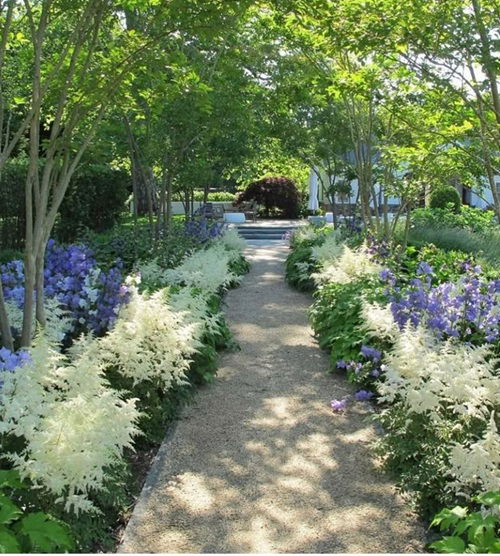
Botanical Name: Astilbe species
USDA Zones: 3-9
Want to see some graceful plumes throughout the spring to fall? Get your hands on Astilbe plants. They are perfect for shady borders and send up beautiful feathery plumes in pinks and whites.
Pro Tip: Keep the soil moist to prolong its bloom.
10. Blue Catmint

Botanical Name: Nepeta x faassenii
USDA Zones: 5-9
Catmint flowers are all about soft fragrances! These bloomers can be a good option for aromatic walkways or front-yard beds to greet your guests with the mesmerizing aroma. Plus, they bloom early and repeat quite well into fall with occasional trimming.
11. Cranesbill

Botanical Name: Geranium species
USDA Zones: 3-9
Geranium species, also known as Cranesbill, are long-flowering, easy-to-grow plants that make pretty borders with their cool-toned flowers. Grow them in well-drained, moist soil and in either sun or partially shaded spots.
12. Coral Bells

Botanical Name: Heuchera species
USDA Zones: 4-9
Planning to create a stunning walkway? Go for Coral bells, you will love their colorful foliage and delicate flowers. Their warm tones and bell-shaped flowers make the best combination!
13. Sedum

Botanical Name: Sedum species
USDA Zones: 3-11
Sedum is also known as stonecrop. It is a low-growing succulent that forms a bushy structure upon maturity and produces compact clusters of tiny flowers that almost appear like broccoli!
14. Lady’s Mantle

Botanical Name: Alchemilla mollis
USDA Zones: 3-8
These are one of the attractive border plants that look great along shaded borders. The lady’s mantle features fan-shaped leaves and flower clusters of tiny, green-yellow flowers that are good for highlighting margins.
15. Daylily

Botanical Name: Hemerocallis species
USDA Zones: 4-9
Daylilies are best for beginner-friendly gardens, thanks to their easy-growing nature! The beautiful border plant sends up flowers daily for weeks during the spring-summer season.
16. Hardy Hibiscus

Botanical Name: Hibiscus moscheutos
USDA Zones: 9-11
Looking for sturdy and tall border plants? Hardy hibiscus stands out with its big, showy blooms that appear continually in warm climates. Additionally, it is ideal for tropical borders or large containers near walkways.
17. Phlox

Botanical Name: Phlox paniculata
USDA Zones: 3-9
Phlox is a mat-forming perennial with vigorous clusters of flowers in many shades that also hold a fresh fragrance distributed in the air. It grows best in moist, well-drained soil that is rich in organic matter and thrives effortlessly in sunny borders.
18. Beardtongue

Botanical Name: Penstemon species
USDA Zones: 3-9
Its tubular blooms on long stalks are a sight to catch! Penstemon plants do not grow more than a meter tall, perfect for walkways and raised bed borders.
Pro Tip: Prune after blooming to encourage a second flush.
19. Yarrow

Botanical Name: Achillea millefolium
USDA Zones: 4-9
Yarrow is a hardy perennial, drought-tolerant, and has flat flower heads in warm shades that last from late spring through fall. It grows well in rock gardens and raised flower beds.
20. Dianthus

Botanical Name: Dianthus species
USDA Zones: 3-9
Dianthus is one that has multiple purposes; it makes a good houseplant in containers, as well as an outdoor garden plant. Additionally, it produces bright, colorful, and cheerful blooms, making it a border favorite.
Caution: The leaves of some Dianthus species are toxic to humans and pets.
21. Ox-eye Daisy

Botanical Name: Leucanthemum vulgare
USDA Zones: 4-8
No wonder these daisy plants are so popular! Features like tiny, round flowers with a yellow center make it appear quite adorable. Plus, these soothing colors contrast amazingly with the dark green leaves, creating a meadow-like appeal.
22. Speedwell

Botanical Name: Veronica species
USDA Zones: 4-9
Pair up Speedwell with lavender flowers and create an illusion of upright spikes of blue, pink, or white flowers that closely resemble Lavender blooms. It can bloom for weeks, and you can trim after the first flush for extended color.
23. Sneezeweed

Botanical Name: Helenium autumnale
USDA Zones: 3-8
Sneezeweed flowers are slightly late bloomers, but the bold, daisy-like flowers are worth the wait! The rich tones make them perfect for transitioning summer to fall borders.
24. Bellflower

Botanical Name: Campanula species
USDA Zones: 4-9
The genus Campanula holds a wide range of 400 species with diverse natures and growing habits. Among them, the best ones for the border plants are Campanula medium and Campanula lactiflora.
These are upright perennials forming a rosette of leaves from which the bell-shaped flowers arise in blue, white, pink, and purple.
25. English Daisy

Botanical Name: Bellis perennis
USDA Zones: 4-8
Also known as the common daisy or lawn daisy, it is popular for its unique red, white, and pink round blooms with yellow eyes.
Caution: English daisies are toxic to humans and pets.
Note: These are often treated as cool-season biennials, blooming primarily in spring and early summer. Not continuous bloomers through summer/fall unless you’re in cooler climates.
Can’t wait to see these beauties? It happens! Take your time and choose according to the climate in your region. When you do, let us know in the comments section below.